For many farmers, fertilizing a crop does not end when the seed goes into the ground.
As the crop grows, there may be another trip to the agrovet for CAN, urea or another nutrient to support the crop through its next stage of development. It is a routine that can add to the cost and labour of farming.
But what if the fertilizer applied at planting could continue feeding the crop as it grows?
That is the idea behind controlled-release fertilizer, a technology that is increasingly being explored as a way of matching nutrient availability with the changing needs of a crop.
At Livatty Africa, agronomist Eliud Leteipa Mukiri describes it in simple terms: a fertilizer designed to release its nutrients gradually rather than making all of them available at once.
“Controlled-release fertilizer is a type of fertilizer that releases nutrients slowly,” he explains.

The principle is not entirely new. Controlled-release fertilizers use coatings or other barriers around nutrient-containing granules to regulate the movement of nutrients into the soil. The objective is to make nutrients available over a longer period and, where possible, better align their release with crop demand.
For the farmer, the attraction is straightforward: fewer applications and more deliberate nutrient management.
Feeding the crop as it grows
Mukiri says the fertilizer offered by Livatty Africa is designed for one application during planting, with the nutrients released progressively over the crop’s growth period.
“It’s just once and that’s all. You apply it during planting,” he says.
He describes this as a “crop time” approach, where the release period is matched to the expected duration of the crop.
“If a crop takes three months, till harvesting, planning to harvesting, it will just use that three months. If it takes four months…” he says.
The logic behind controlled release is that crops do not require exactly the same nutrients, in the same quantities, at every stage of their development.
At the beginning, the plant is establishing its roots. It later moves into vegetative growth before progressing towards flowering, fruiting, bulking or harvest, depending on the crop.
A fertilizer that releases nutrients progressively is therefore intended to reduce the gap between when the nutrient is placed in the soil and when the crop actually needs it.
Research into controlled-release fertilizers similarly points to their potential to synchronise nutrient supply with crop demand while reducing nutrient losses through processes such as leaching and volatilisation.
Not every crop has the same appetite
The other part of the equation is that there is no single fertilizer formulation that works in exactly the same way for every crop.
Mukiri points to different NPK formulations displayed by the company, including 14-14-14, which he describes as a balanced fertilizer.
Then there are formulations targeted at particular crops.
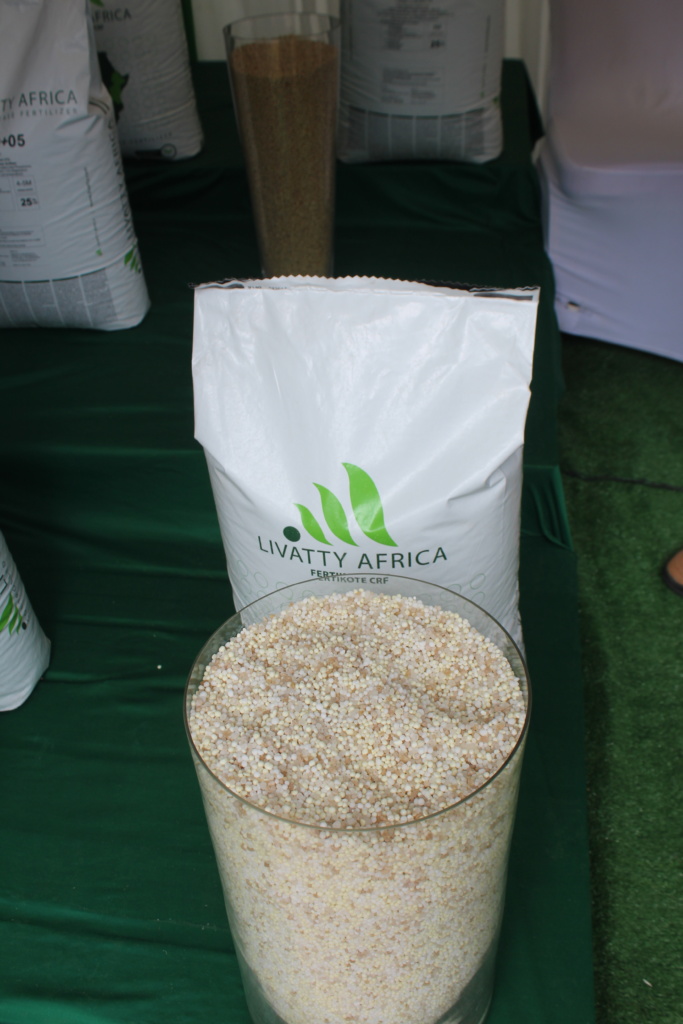
“We have 28, 5, 5, 7,” he says, identifying it as a formulation suited to flowers. “We have 18, 6, 12” for avocado and another formulation he associates with potatoes.
The underlying message is that fertilizer application is increasingly moving towards crop-specificnutrition, rather than simply asking farmers to apply more fertilizer.
That distinction matters.
The three major nutrients represented by NPK—nitrogen, phosphorus and potassium—play different roles in plant development. The challenge for growers is not merely supplying them, but ensuring that the plant has access to the nutrients it requires at the appropriate stage.
For controlled-release fertilizers, the coating around the granule is central to this process. Water enters the coating, dissolves the nutrients and allows them to move gradually into the soil. The speed of release can depend on factors including the coating, soil moisture and temperature.
But what happens to the soil?
There is another question that follows naturally.
Controlled release may help manage nutrients more efficiently, but Livatty’s product is still a synthetic, inorganic fertilizer.
For farmers who are increasingly concerned about soil health, that raises an important question: what happens when synthetic fertilizers are used repeatedly over time?
Mukiri’s response is that the answer lies partly in how the fertilizer is used.
“Anything in excess in this world is poisonous,” he says, emphasising the importance of applying fertilizer at the recommended rate.
He says the company advises farmers to undertake soil analysis before deciding on the appropriate application.
During demonstrations and farm visits, he says, farmers are encouraged to collect soil samples and take them for laboratory analysis. The results can then guide agronomic recommendations.
“If this soil is so much acidic, let’s use lime,” he explains.
That emphasis on soil testing is significant. Fertilizer technology cannot substitute for understanding the soil into which the fertilizer is being applied. Controlled-release products still need to be matched to the crop, soil conditions and application requirements.
Indeed, recent research notes that the performance of controlled-release fertilizers varies according to crop, soil, climate and application strategy; the technology is not a universal solution that can simply be applied identically everywhere.
The question of value
Ultimately, however sophisticated a fertilizer may be, farmers are likely to ask one question before adopting it:
Does it make economic sense?
Mukiri says the company has received positive feedback from farmers and points to demonstrations conducted with growers, including flower producers in Naivasha.
He cites Birds and Blooms, a flower farm in the area, as one of the farms where demonstrations have been undertaken.
“We conducted demos in their farm, made them see through their eyes,” he says, describing the approach as allowing farmers to compare the performance of the product under actual farm conditions.
For potato and other crop farmers, he also speaks of improved returns from demonstration plots. But the precise figure he gives in the interview requires clarification before it can be treated as a verified yield or income statistic.
That distinction is important because the economics of controlled-release fertilizer cannot be judged by the fertilizer bag alone.
Farmers have to consider the price of the product against the cost of labour, the number of applications avoided, nutrient-use efficiency, crop yield and ultimately the value of the harvest.
Controlled-release fertilizers can potentially reduce the frequency of applications and improve nutrient-use efficiency, but their higher cost compared with conventional fertilizers remains one of the barriers to wider adoption.
Agriculture is changing
For Mukiri, however, the conversation goes beyond one fertilizer.
He says Livatty Africa also works with farmers on foliar products and fertigation, among other crop-care solutions.
And from his interactions with farmers and fellow agronomists, he sees an industry that is constantly changing.
“Agriculture is a dynamic area,” he says. “Growing each and every second.”
For him, that means today’s solution cannot necessarily be assumed to be tomorrow’s best solution.
“If we have another product that is more efficient, more better of controlling that particular thing,” he says, farmers and agronomists have to be willing to adapt.
That may ultimately be the bigger story behind controlled-release fertilizer.
It is not simply about putting a smarter granule into the soil. It is about changing the way farmers think about crop nutrition, from applying nutrients because the crop has reached a certain stage, to asking what the plant needs, when it needs it, and how efficiently that nutrient can reach the root zone.
As pressure grows to produce more from existing land while managing input costs and environmental impacts, that question is likely to become increasingly important.
And perhaps the future of fertilizer will be less about feeding crops more, and more about feeding them better.