
Investing in climate adaptation isn’t just a good idea; it’s a financially smart one. Research by the World Resources Institute shows that every dollar invested in adaptation can yield returns of up to $10. This impressive return is part of what they call the “triple dividend of resilience,” which includes avoided losses, positive economic benefits, and social and environmental benefits.
To truly empower communities on the front lines of climate change, we need to do more than just provide funding. We must also equip them with the knowledge and tools to act. This includes education on early warning systems and preparedness strategies, allowing them to take timely and effective action to build resilience against climate shocks.
Financing adaptation has faced challenges, including a lack of complete understanding of both risks and returns, which are often not accurately calculated and priced.
A World Resources Institute working paper reveals that, despite increases in financial flows, a gap remains in adaptation finance for assured resilience. Adaptation finance flows more than doubled between 2018 and 2022, with public finance accounting for 92 percent (70 billion of the 76 billion tracked over these five years (CPI 2024).
However, the United Nations Environment Programme (UNEP) warns that the “adaptation finance gap,” the difference between estimated global adaptation financing needs and actual financial flows, continues to widen and now ranges from $187–359 billion annually (UNEP 2024).
According to Global Commission on Adaptation, for instance, highlighted the extremely high returns on adaptation investments, estimated to be up to 10 times larger than their cost, in five key areas: early warning systems, resilient infrastructure, productive dryland agriculture, mangrove protection, and resilient water resources management (Global Commission on Adaptation 2019).
Adaptation has shown indicators of triple benefits when well implemented, as it not only ensures losses are avoided but also enables the delivery of economic, social, and environmental returns. This is evident in the working paper by the World Resources Institute, “Strengthening the investment case for climate adaptation: A triple dividend approach.”
The study focused on the evaluation of up to 320 adaptation investments approved by the Multilateral Development Banks (MDBs) and for implementation in 12 countries across four key sectors: agriculture, health, water, and infrastructure, from 2014 to 2024.
An evaluation revealed that relevant adaptation investment data is unavailable for most countries, including from Nationally Determined Contributions (NDCs) and National Adaptation Plans (NAPs). Moreover, only a minority of developing countries have clear and well-costed adaptation plans, whether in national development plans, NDCs, or NAPs.
A clear indication that climate budgeting is still in its early stages and primarily tracks expenditures, with few countries conducting economic analyses of adaptation capital expenditures, hence a scarcity of information.
The criteria undertaken in the study involved compilation of investments into the Adaptation Triple Dividend of Resilience (AdapTDR) database, which details their objectives, components, costs, benefits, net present values (NPVs), and economic internal rates of return (EIRRs) using standard cost-benefit analysis (CBA) and the Triple Dividend Research framework.
Based on the study, the benefits of adaptation investments fall across three dividends: that is, avoided losses (first dividend), induced economic development (second dividend), and social and environmental benefits (third dividend).
Interestingly enough is the fact that the second and third dividends have proven to exceed the first one of avoiding losses in driving high returns on investment (ROIs). The returns are way high since they aren’t just monetary but rather, they entail a wider spectrum of advantages, some of which can’t be monetized.
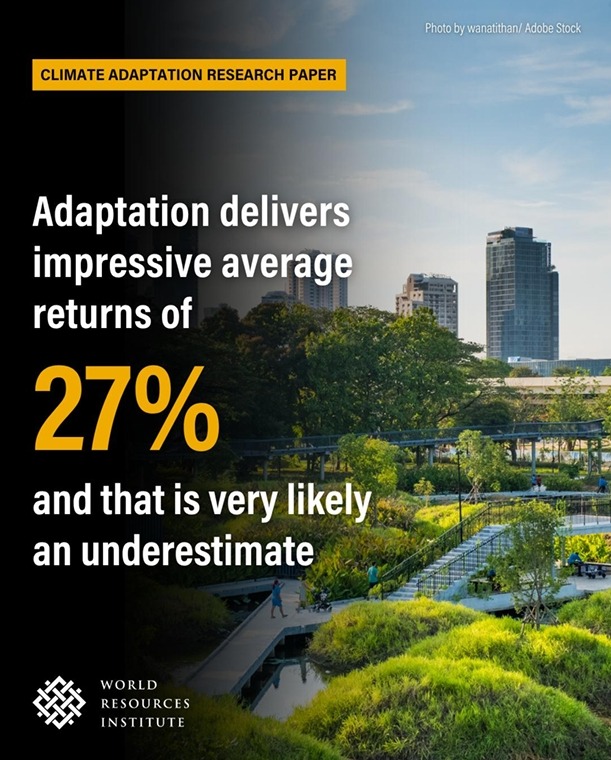
With a guaranteed 27% average ROI, adaptation offers high ROIs for the health and disaster risk management subsectors are driven by reduced mortality (first dividend), while the high returns in sustainable agriculture and forestry subsectors are based on poverty reduction (second dividend) and mitigation co-benefits (third dividend).
The study emphasizes that half of the evaluated adaptation investments yield mitigation co-benefits, demonstrating adaptation’s alignment with climate mitigation goals. Considering that climate adaptation and mitigation are intrinsically connected, these synergies could strengthen the investment case for adaptation and point to further financial opportunities through carbon markets.
Overall, US$1 invested in adaptation is expected to yield over $10.50 in benefits over 10 years. The evaluated investments cost $133 billion in total and may generate benefits of $1.4 trillion, with average returns of 27 percent.


