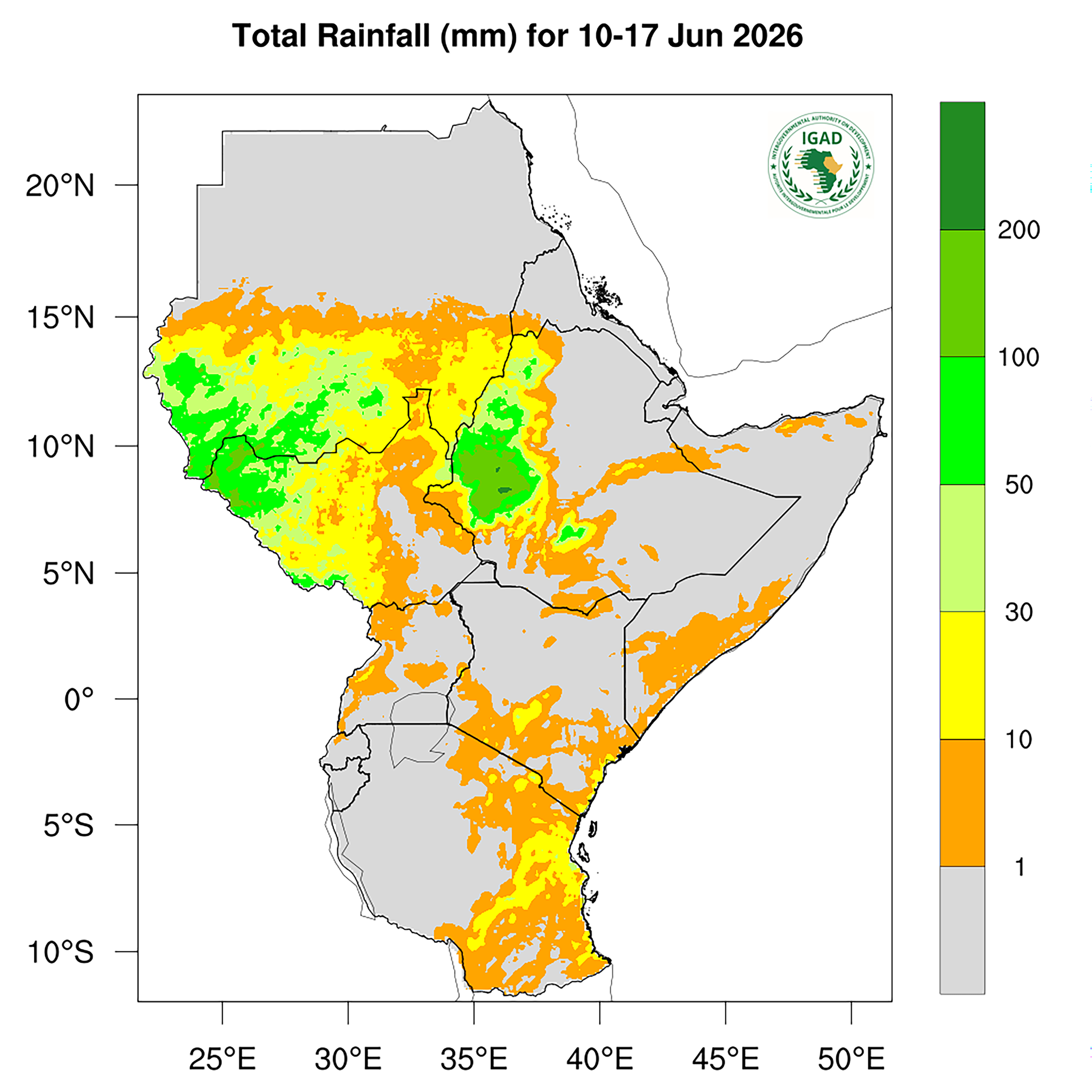
Large parts of Eastern Africa are set to receive above-normal rainfall between 17 and 24 February 2026, raising the likelihood of localized flooding while intensifying heat stress in eastern sections of the region.
According to the latest regional forecast from the IGAD Climate Prediction and Applications Centre (ICPAC), enhanced rainfall is expected over most of Tanzania, Rwanda, Burundi, south-western Kenya, and central to western Uganda.
The outlook signals a week of hydrological contrasts, with heavy downpours in some areas and persistent heat stress in others.
Heavy Rains Concentrated in Tanzania and the Great Lakes Region
Southern Tanzania is forecast to receive heavy rainfall exceeding 200 mm, while moderate rainfall ranging between 50 and 200 mm is expected across most of Burundi, Rwanda, Tanzania, and south-western Kenya. Lighter rainfall totals of less than 50 mm are projected over most parts of Uganda and southern South Sudan.
Forecasters note that 1 millimeter of rainfall is equivalent to one liter of water per square meter, a reminder of how quickly cumulative precipitation can translate into saturated soils and rising river levels.
Rainfall is expected to exceed seasonal averages across much of Rwanda and Burundi, as well as northern, eastern, and southern Tanzania.

Above-normal rainfall is also projected for south-western Kenya, central to western Uganda, and southern South Sudan. In contrast, parts of western Tanzania may experience slightly drier-than-usual conditions.
Of particular concern is the likelihood of exceptional rainfall, defined as precipitation exceeding the 90th percentile, over eastern Rwanda and Burundi, alongside parts of northern and southern Tanzania. Such extremes significantly increase the risk of flash floods and riverine flooding.
Eastern Rwanda and Burundi, together with northern and southern Tanzania, are identified as flood-prone hotspots during the forecast period.
Communities in vulnerable low-lying and floodplain areas are being urged to remain vigilant, especially near rivers, drainage channels, and urban centers with limited stormwater infrastructure.

Flooding in these regions can disrupt transport networks, damage crops, and increase the risk of waterborne diseases, particularly where drainage systems are overwhelmed. Early preparedness measures, including monitoring local advisories and safeguarding essential assets, are critical to reducing impacts.
Warm Conditions Persist Across Eastern Africa
Alongside the rainfall outlook for Eastern Africa, moderate to high temperatures ranging from 20°C to 32°C are expected across most of Tanzania, Kenya, Uganda, Somalia, South Sudan, Sudan, Ethiopia, Djibouti, and Eritrea.

Milder conditions below 20°C are forecast in parts of north-western Sudan, central Ethiopia, central to western Kenya, northern Somalia, and western areas of Rwanda and Burundi.
Temperature anomalies indicate that most of the Greater Horn of Africa will experience warmer-than-usual conditions for this time of year.
However, pockets of cooler-than-average temperatures are anticipated in south-western Tanzania and parts of western Kenya, as well as isolated zones elsewhere in the region.
Elevated heat stress, categorized under the “Extreme Caution” threshold, is expected to affect eastern Tanzania, eastern South Sudan, and eastern Kenya, extending into southern Somalia.
Prolonged exposure to such conditions can heighten health risks, particularly for outdoor workers, children, and older populations.

Balancing Water Abundance and Climate Risks
The week ahead outlines East Africa’s growing exposure to climate variability, where intense rainfall and rising temperatures can occur simultaneously across neighboring regions.
While enhanced precipitation may support water resources and agriculture in some areas, the associated flood risks and heat stress highlight the need for coordinated early warning systems and community preparedness.
Regional climate services continue to play a vital role in translating forecasts into actionable guidance, enabling governments and communities to anticipate hazards and protect lives and livelihoods.