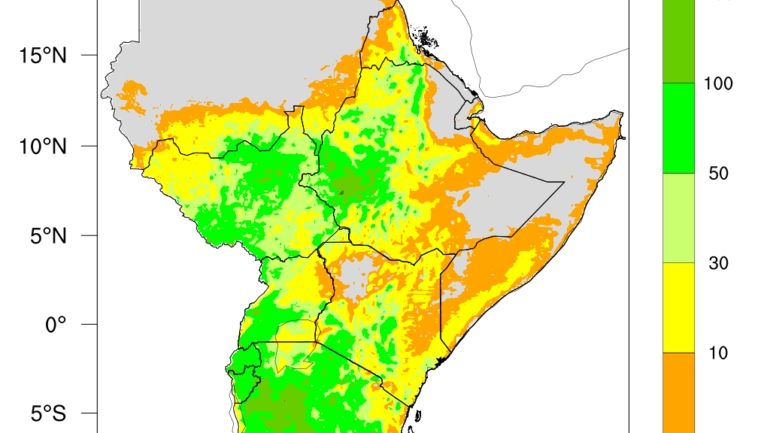
The IGAD Climate Predictions and Applications Center (ICPAC) weekly forecast for the Greater Horn of Africa (GHA), covering Eastern Africa IGAD member states, indicates a mixed pattern of enhanced rainfall alongside warmer-than-average temperatures during the period 4–11 February 2026.
The forecast illustrates enhanced rainfall expected across Rwanda, Burundi, and central to eastern Tanzania, while much of the Greater Horn of Africa is anticipated to experience above-average temperatures, raising concerns over heat stress in several regions.
Heavy rainfall exceeding 200 mm is expected over isolated areas of southern Tanzania, while moderate rainfall ranging between 50–200 mm is forecast over most parts of Burundi, Rwanda, and Tanzania.
Meanwhile, light rainfall of less than 50 mm is expected over southern and western Uganda, south-western Kenya, and north-western coastal regions of Somalia, indicating relatively drier conditions in these areas.
Rainfall anomaly analysis further shows above-normal rainfall expected over most parts of Burundi, Rwanda, and eastern and southern Tanzania, while below-normal rainfall is forecast in parts of western Tanzania, highlighting a strong spatial contrast within the country.

The forecast also indicates the occurrence of exceptional rainfall, with amounts exceeding the 90th percentile, particularly over central and southern Tanzania. Green shades on the anomaly maps denote areas receiving above-average rainfall, while yellow to red shades indicate below-average rainfall, with deeper red tones reflecting more significant deficits.
Southern Tanzania stands out sharply, with eastern and southeastern parts expected to record rainfall anomalies exceeding +40 to +60 mm in some areas. In contrast, southwestern Tanzania is projected to experience suppressed rainfall, suggesting potential short-term dryness. Most parts of Kenya, Ethiopia, Somalia, and South Sudan are expected to experience near-normal rainfall, with only isolated pockets of slightly above-average precipitation.

About exceptional rainfall, light blue shading indicates heavy rainfall, medium blue denotes very heavy rainfall, and dark blue represents extremely heavy rainfall. Southern and southeastern Tanzania once again emerge as rainfall hotspots, with several areas expected to experience very heavy to extremely heavy rainfall, pointing to intense short-duration downpours.
Northern Tanzania and areas near Lake Tanganyika are also expected to receive heavy rainfall episodes, though with comparatively lower intensity. Much of the remaining IGAD region is forecast to experience limited or no extreme rainfall, suggesting relatively stable conditions elsewhere during the week.
Temperature Forecast for 04–11 February 2026 in the IGAD Region
ICPAC’s temperature outlook indicates moderate to high mean temperatures ranging between 20°C and 32°C across most parts of Tanzania, Kenya, Uganda, Somalia, South Sudan, Djibouti, Eritrea, and central to southern Sudan.
Milder temperature conditions of below 20°C are expected over parts of central Ethiopia, central Kenya, south-western Tanzania, and western regions of Rwanda and Burundi, largely influenced by elevation and localized cloud cover.
Temperature anomaly analysis shows that warmer-than-usual conditions are expected across most of the Greater Horn of Africa, reinforcing a broader regional heat signal. This trend points to heightened heat stress, particularly in areas where elevated temperatures coincide with limited rainfall, increasing the risk of drought and food insecurity.

Elevated heat stress within the “Extreme Caution” category is expected over eastern Tanzania, eastern South Sudan, eastern Kenya, and extending into southern Somalia.
Extremely hot conditions are anticipated across the northern belt of Sudan, South Sudan, Eritrea, and northern Ethiopia, where mean temperatures are expected to range between 32°C and above 40°C, reflecting intense heat.
The Horn of Africa, including Somalia and eastern Ethiopia, is expected to experience consistently warm conditions, with temperatures largely between 28–34°C.
In contrast, equatorial and highland regions such as parts of Kenya, Uganda, Rwanda, Burundi, and the Ethiopian highlands are projected to record cooler average temperatures ranging between 16–24°C, driven primarily by elevation and persistent cloud cover.
Southern Tanzania and areas surrounding large water bodies are expected to maintain moderate temperatures between 22–28°C, with localized cooler pockets around Lake Victoria and highland zones, consistent with increased rainfall and cloudiness.

The forecast aims to enhance early awareness and preparedness, particularly in northern IGAD countries where sustained above-normal temperatures may heighten heat-related health risks.
Farmers, pastoralists, and local communities, especially in Arid and Semi-Arid Lands (ASAL) counties, are advised to remain alert to potential water stress where heat coincides with near-normal or below-normal rainfall.
For wetter regions, particularly southern Tanzania, the risk of flooding and waterlogging remains elevated, alongside potential impacts associated with high humidity.
Overall, the forecast reinforces a regional pattern of warming extremes, consistent with broader climate change trends across Eastern Africa, emphasizing the importance of continuous monitoring and early warning systems.