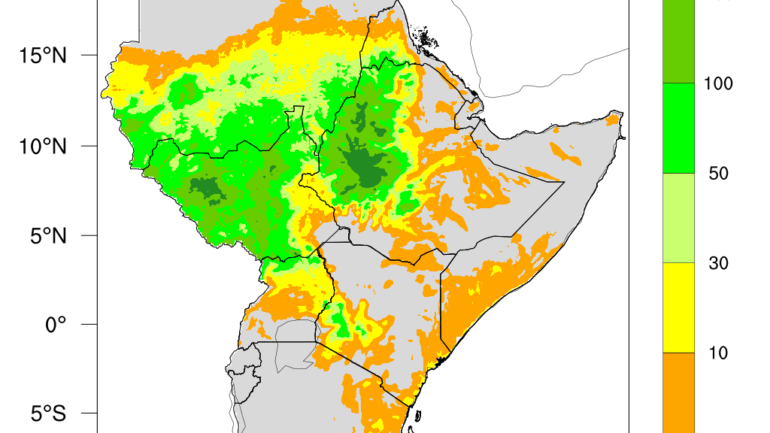
Based on the IGAD Climate Predictions and Applications Center (ICPAC), communities in central and southern Tanzania are likely to face an elevated heavy rainfall risk in the coming days with moderate to heavy rainfall, while warmer-than-average temperatures are expected across the Greater Horn of Africa (GHA).
The weekly forecast of 27th January to 3rd February 2026, released by ICPAC, showcases the extreme opposites anticipated in the eastern Africa region.
Rainfall totals exceeding 200 millimetres are expected over parts of southern Tanzania, with 50–200 millimetres forecast across most of Tanzania and Burundi. These amounts have the possibility of increasing the likelihood of flooding, particularly in low-lying and flood-prone areas,
In contrast, light rainfall in the Greater Horn of Africa is expected to be less than 50 millimetres along the Red Sea coast, northern Somalia, southern Uganda, northern Tanzania, south-western Kenya, and much of Rwanda. This is then an indication that there will be continued dry conditions in majority of these regions.
Rainfall anomaly patterns indicate above-average rainfall over most parts of Burundi, Rwanda, central to eastern Tanzania, and south-western Kenya, while pockets of western Tanzania are expected to receive below-average rainfall.

Taking a look at the map, we realize strong positive anomalies (green shades) dominate southern and south-eastern Tanzania, indicating significantly above-average rainfall. This is similar to parts of Burundi, Rwanda, and south-western Kenya, which also show wetter-than-normal conditions, though less intense.
Notably enough are the negative anomalies (yellow to red shades) visible in pockets of western Tanzania, signalling below-average rainfall in those areas. Most of the northern Horn, including Somalia, eastern Ethiopia, Eritrea, and Sudan, shows near-normal to dry conditions.
For exceptional rainfall, it’s apparent that Central and southern Tanzania are flagged for heavy to extremely heavy rainfall, with some areas expected to exceed the 90th percentile. The 90th percentile means such rainfall occurs only about once in ten years or less.
These conditions are considered capable of arousing a risk of flooding, flash floods, and infrastructure damage, especially in low-lying and flood-prone zones. It’s apparent then that there is no exceptional rainfall signal shown across most of Kenya, Uganda, Somalia, Ethiopia, and Sudan, indicating lower short-term flood risk in those regions.

The Temperature Forecast for the Greater Horn of Africa, 27th January to 03rd February
As illustrated by the maps, temperature forecasts show moderate to high temperatures ranging between 20°C and 32°C across the Greater Horn of Africa. This can be observed over much of Tanzania, Kenya, Uganda, Somalia, South Sudan, Djibouti, and southern Sudan, as in the figures below.
For the region, it is generally expected that warmer-than-usual temperatures are to dominate most of the GHA during the forecast period. Yet cooler conditions, below 20°C, are also expected in northern Sudan, central Ethiopia, parts of central Kenya, south-western Tanzania, and western Rwanda and Burundi.
This heat, combined with rainfall patterns, is likely to exacerbate climate-related risks; hence, early awareness is urged among citizens in the region for adequate preparation.

The map shows significantly warmer-than-usual conditions across the Horn of Africa, the Red Sea basin, and Arabia. Also indicating near-normal to slightly cooler-than-usual conditions in the equatorial heart of East Africa (the Great Lakes region and Tanzania). The transition between warm and neutral anomalies runs roughly along the Ethiopia-Kenya border.
In essence, the heat anomaly is focused on the dry, arid regions of northeast Africa and Arabia, while the typically wetter, equatorial regions show little to no warming or even slight cooling. This pattern points to a need for preparation to face drought risk, agricultural challenges, and human health conditions in the warmer zones.
The ICPAC forecast further highlights a projection of heat stress levels to a possible “Extreme Caution” category across eastern Tanzania, central to eastern South Sudan, and eastern Kenya, extending into southern Somalia. These predictions raise concerns of public health issues, conditions of outdoor labourers, and vulnerable populations.

As climate variability intensifies across the region, authorities are rolling out early preparedness warnings to inform communities. Hence a constant call out to citizens to remain alert, monitor local advisories, and take early action to reduce flood and heat-related risks.